Re-introducing The Spark
Why Conscious Systems Matter for the Next Generation
When Covid hit, I stopped everything. I quit my job, got rid of my apartment, dropped all to-do lists and sat with the discomfort that nothingness often creates.
I made myself stop because I knew I was missing something. For nearly twenty years I’d worked with children and young people in various capacities, but I no longer felt as though I was making an impact. The scale of challenge felt so big, and my efforts so small, and I knew I was overlooking something vital.
Then, when I was least expecting it, The Spark was born on a windy beach in Cornwall, South West England, as I sat with paper and pen waiting for inspiration to strike. And strike it did! It came as a fully-formed idea, more of a remembering than an imagining. I knew (with a physical as well as mental knowing) that bringing forth a spiritual perspective on childhood, adolescence, education and raising children was part of my future role. But until recently, I struggled to see where this work could fit. How do you introduce ideas to the world that are new or unusual or challenging?
Over the past few years, my day to day work has increasingly focused on a central question: What are the conditions that allow people to truly thrive — and create meaningful change?
This question has shaped my work with organisations, partnerships and changemakers. But now it also brings me back to where this work originally began: children and young people.
The Spark Movement was created to explore this space. And as my wider work has evolved, its role has become clearer: not separate from that work, but foundational to it.
The Challenge We’re Facing
Across education, youth services and society more broadly, there is growing recognition that something isn’t fully working for children and young people.
We see it in:
- Rising levels of anxiety and mental health challenges
- Increasing pressure to perform, achieve and conform
- Disconnection from identity, purpose and belonging
- Systems that prioritise outcomes over experience
At the same time, we are preparing children for a future that is uncertain, rapidly changing and increasingly complex. And yet many of the systems designed to support them are still rooted in older models, focused on control, standardisation and narrow definitions of success.
This creates a tension:
We are asking young people to navigate a complex, evolving world, while supporting them through systems that are not designed for that reality.
Why “Conscious” Approaches Matter
When I talk about a more conscious approach, I’m not referring to something abstract or idealistic. I’m talking about practical shifts in how we understand and support human development.
A conscious approach recognises that:
- Children are not empty vessels to be filled – they are individuals with innate capacities, perspectives and potential
- Development is not just cognitive – it is emotional, relational and embodied
- Behaviour is shaped by environment, relationships and internal experience, not just rules or discipline
- The way adults show up matters as much as what they teach or say
This shifts the focus from:
- Control → Understanding
- Compliance → Connection
- Performance → Development
- Standardisation → Individuality
These shifts are not “nice to have”, they are essential if we want to raise individuals who can think critically, relate well to others, and navigate complexity with confidence. And just as the broader shifts in other areas of life are requiring us to rethink what we habitually do, so too will this shift require us to fundamentally rethink what we took to be gospel, including the role of adults in raising kids, and how we relate to children.

The Role of Conditions in Childhood
One of the core ideas running through all of my work is this: Conditions shape behaviour, experience and outcomes.
For children, these conditions include:
- Whether they feel psychologically safe
- Whether their voice is heard and valued
- Whether difference is accepted or suppressed
- Whether relationships are built on trust or authority
- Whether mistakes are treated as learning or failure
These factors fundamentally shape self-esteem, identity, agency, resilience and their capacity to engage with the world. We tend to focus on what children learn, but the conditions around how they learn are just as important, if not more so.
The Spark Movement exists to explore and respond to this space. It focuses on how we create the conditions for children and young people to:
- Understand themselves more deeply
- Develop a sense of identity and purpose
- Build emotional and relational awareness
- Recognise and express their unique strengths
- Engage with the world as active participants, not passive recipients
One of the ways this comes to life is through tools like the Signature Sparks: a framework designed to help children identify and explore their natural ways of thinking, feeling and contributing.
This is not about labelling or limiting children. It’s about giving them language and insight into who they are, so they can navigate the world with greater confidence and self-awareness. More on this to come.
What You Can Expect
Moving forward, The Spark will be a space for:
- Practical tools and resources for parents, educators and changemakers
- Clear, accessible explanations of key concepts (e.g. identity, behaviour, relational dynamics)
- Reflections on the systems shaping childhood today
- Exploration of what future-ready, human-centred approaches could look like
The intention is to make this work grounded, useful and thought-provoking, whether you’re a parent, carer, educator, changemaker focused on youth, or anything in between. I fundamentally (and passionately) believe that each and every one of us has an important role to play to create the right conditions for future generations. Whether we have children of our own, or not, or work in a youth-facing role, or not, we are collectively creating a legacy for future humans. It’s time we did so intentionally, consciously, and creatively.
In the six years since the idea of the Spark landed in my consciousness a lot has changed for me personally, and in the world at large. I’m not the same person I was when I set out to create something that blended my passions of working with children with my spiritual beliefs and my desire to lead a purposeful life. Grief, illness, divorce, change – it’s all part of life and shapes who we are and how we show up. The wider world has echoed this personally challenging period, in the chaotic politics, wars and conflict, covid fallout and AI explosion. Change is now a constant, not an occasional experience.
All of these experiences – personal and global – have left their mark and have influenced the work I’m choosing to do in the world. I wholeheartedly believe that the future will require humans who are much more self-aware, emotionally and relationally intelligent, adaptable, able to collaborate across difference and grounded in a sense of purpose. This starts with me, as an individual.
We know that these capacities don’t develop by accident. They are shaped – intentionally or unintentionally – by the environments we create. The question is: Are we creating the conditions that will allow the next generation to thrive?
Thanks for being with me on this journey to ignite the Spark – both in ourselves, and in the children we care about. Learn more about my wider work at www.NikkiGiant.com

About
the author
Hi, I'm Nikki
I created The Spark when I realised I’d lost touch with my own inner light, buried under years of over-work and overwhelm. After witnessing far too many children becoming smaller versions of themselves, shrinking back, disconnecting and becoming disillusioned, I’m on a mission to ignite my Spark to help children to find theirs, changing the way we nurture small humans into being.
What started as a journey of self-discovery is growing into a global movement to create a better childhood for all children and young people. Will you join me?
Follow Nikki:
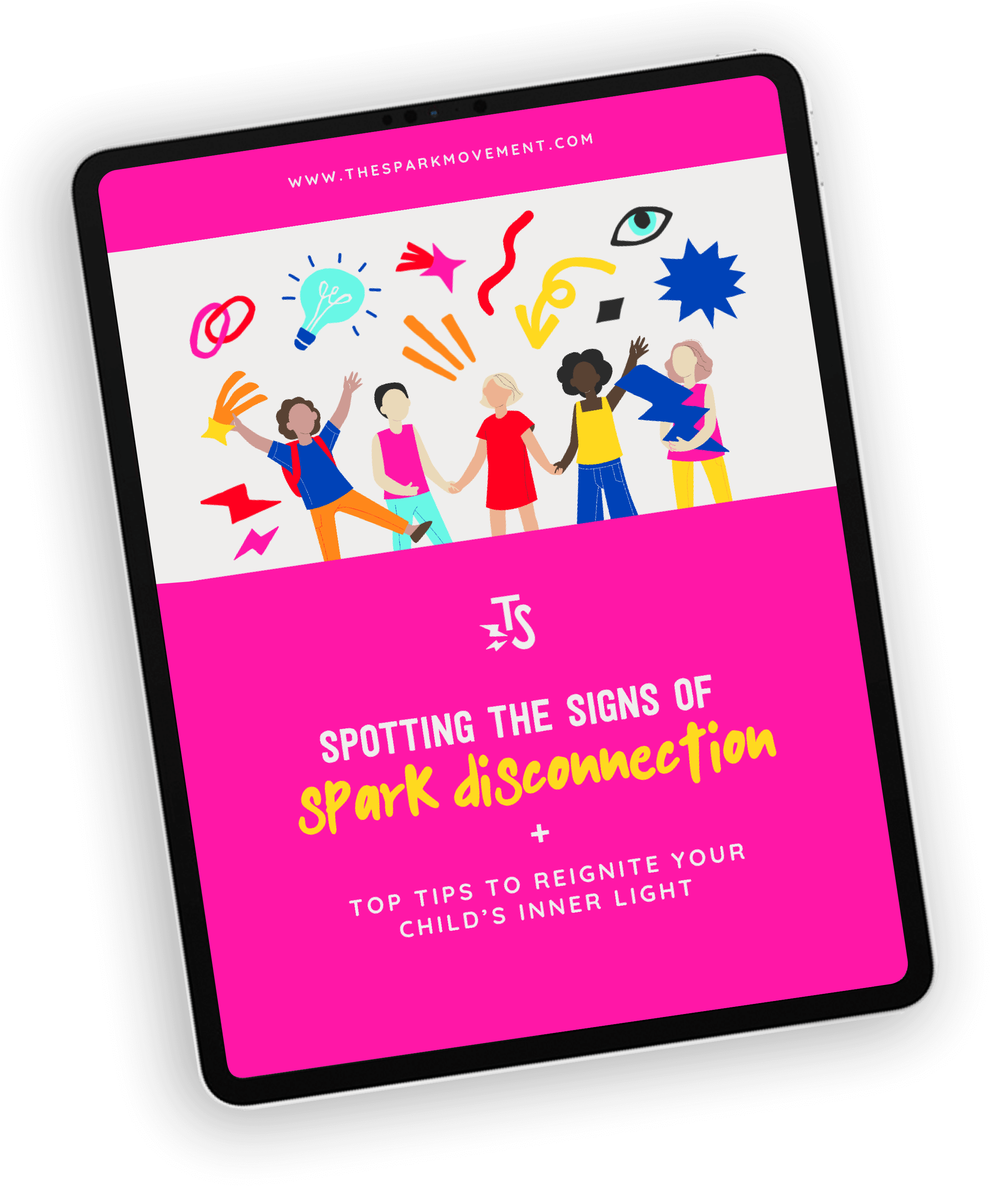
Need help to reignite your
child’s Spark?
Get our free guide to spot the telltale signs of Spark disconnection and learn how to reconnect your child to their inner light and joy.
Tell me more!
Sign up to our newsletter to be the first to hear about our tips, tools and training that will change the world for children.